Last edited by shiny on November 17, 2026. View history
Mexican Tea
 Mexican Tea
How to sow Mexican tea: Direct seed outdoors, thin to 15cm
Sun requirement for Mexican tea: Plant in Full Sun
Epazote is an annual or short-lived perennial herb native to Central and South America that is grown for culinary and medicinal uses. The serrated leaves grow in a radial pattern from a central, upright stem, and the plant has small green flowers. Leaves are used as a vegetable, herb, and to make teas. It is used to season a variety of traditional Mexican dishes, and is often added to black beans because it has a gas-relieving effect. Like cilantro, Epazote has a pungent, polarizing taste that is described in a variety of ways: like oregano, anise, and fennel, or - on the opposite end of the spectrum - like turpentine, gasoline, or creosote. Medicinally, a tea made from the leaves is used to treat intestinal parasites. Epazote can also be used as a companion plant: it contains terpene compounds, which have natural pesticidal properties, and it’s pungent odor can mask the scent of nearby plants to certain insects. Epazote readily self-sows and can become invasive if not properly managed.
- 0
- plantings
- 0
- harvests
- 0
- seed packets

Mexican tea facts
Lifespan
Height × spread
90cm × 90cmRow Spacing
30cmCrop cycle
Max altitude
Optimal light
What are growing degree days?
A plant grows with warmth, not with days. A growing degree day is one day's worth of useful warmth: how many degrees the day's average temperature is above the lowest temperature the crop grows at. Add them up from planting and you know how far along the crop is, whatever the calendar says.
Say that lowest temperature is 10°C. A day averaging 17°C gives 7 growing degree days. A day averaging 8°C gives none, as it is too cold for the crop to grow. That is why the same lettuce takes about 50 days in a summer and 90 in an autumn: it needs the same total warmth either way.
For Mexican tea, the FAO EcoCrop database gives a lowest growing temperature of 4°C and a shortest growing cycle of 150 days at its best temperature, about 2175 growing degree days to a first harvest.
Where you've told us where your garden is, we use this and the weather there to predict when your Mexican tea will be ready to harvest. We don't use it for how long a plant lives or when it finishes: we go by what members have logged for that.

Photos
 Photos
Mexican tea crops
What people are saying about Mexican tea
Nobody has posted about Mexican tea yet.
Sign in or sign up to post your tips and experiences growing Mexican tea.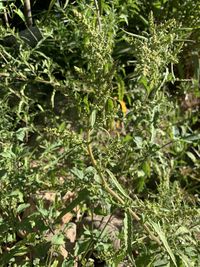
Who's planted Mexican tea
Nobody has planted this crop yet.
Sign in or sign up to track your Mexican tea plantings.Mexican tea harvests
Nobody has harvested this crop yet.
Sign in or sign up to track your Mexican tea harvests.Find Mexican tea seeds
There are no seeds available to trade on Growstuff right now.
- Purchase seeds via Ebay
- Sign in or sign up to list your seeds to trade.
Time to harvest
If sown now, expect a first harvest in about 150 to 210 days.
From the growing cycle in the FAO EcoCrop database, which is the same wherever it is grown.
Ecological requirements
Data from the FAO EcoCrop database for Chenopodium ambrosioides L.
| Family / Taxonomy | Magnoliopsida Caryophyllidae Caryophyllales Chenopodiaceae |
|---|---|
| Killing temperature | growth: -1 °C, rest: -2 °C |
| Life form | herb |
| Life span | annual, perennial |
| Habit | erect |
| Optimal soil depth | medium (50-150 cm) |
| Optimal soil texture | medium |
| Optimal soil fertility | high |
| Optimal soil drainage | well (dry spells) |
| Optimal soil salinity | low (<4 dS/m) |
| Photoperiod | short day (<12 hours) |
Learn more about Mexican tea
Resources outside Growstuff.
